New Book: ‘A Short History of Russia’

SHoR-UK-bookphoto

I’ve just received the advance author’s copy of the UK version of my new book ‘A Short History of Russia‘ (all Russian history in 190 pages!). Because of the impact on COVID-19 on the world of the physical bookshop, in the UK publication with Ebury Press (Penguin Random House) is being delayed until February 2021 (instead of the end of April, as originally intended), but it is still scheduled to come out in the USA with Hanover Square Press in July 2020.


New Book: Combat Vehicles of Russia’s Special Forces

Update (11 May 2020): I have just received my author’s copies, so this is definitely still on track to come out on 28 May 2020 – some photos of inside pages are below. On a less positive note, a mix-up led to a mis-identification of a GAZ Tigr for a Taifun-K on one photo on page 45. Sadly, these things happen.

IMG_20200511_103911IMG_20200511_103940IMG_20200511_103956

Admittedly, a touch more recondite than A Short History of Russia, but my next book from Osprey, due out in May, will be Combat Vehicles of Russia’s Special Forces, now available for pre-order. Given that I am not a tech-head, and that this covers a whole range of vehicles rather than a single design or line, instead of the detailed discussion of engines, fire control systems and gun types some of the New Vanguard series features, this is much more of a tour around the various specialist vehicles employed today, from quad-bikes to air-droppable mini-tanks, and what it says about Russian military (and Rosgvardiya) intent and capabilities. (There’s also some speculation about future designs, like the Naval Infantry’s new marine assault vehicle.)

Of course, as you can see from the above compound on one of his preliminary sketches and the final, it has the usual great art, this time by Adam Hook, as well as lots of photos, including many from the incomparable Vitaly Kuzmin.

Here’s the blurb:

Elite forces need elite vehicles. As Vladimir Putin has devoted effort and funds into modernising Russia’s armed forces and turning them into an instrument geared not just for defending the Motherland but also projecting power beyond its borders, Russia has seen a growing emphasis on special and specialist forces. Traditionally, the elite Spetsnaz commandos had to make do with regular vehicles or civilian-based ‘technicals’, not least to conceal their presence (or, indeed, very existence). Now, increasingly at the forefront of Russian power projection, the Spetsnaz are acquiring more capable, versatile vehicles, such as the paratroopers’ BTR-D personnel carrier, and also experimenting with exotic, specialist new acquisitions, such as the Chaborz M-3 buggy and Yamaha Grizzly all-terrain vehicle.

The other elite branches of Russia’s forces, such as the Arctic-warfare troops of the 200th Independent Motor Rifle Brigade, the paratroopers of the Air Assault Troops (VDV), the Naval Infantry, and the elite units of the security forces are also developing and fielding new vehicles for their specialist roles, from combat snowmobiles to urban-warfare vehicles. From highly-mobile LMVs able to operate in the deserts of Syria or the streets of Ukraine, through dedicated fire-support vehicles such as the air-droppable Sprut-SD or the massive BMPT ‘Terminator’, to amphibious tanks and drone-equipped security trucks, these are the workhorses of Russia’s special forces. This study explores all these combat vehicles in detail, combining expert analysis from Russia expert Mark Galeotti with highly accurate full-colour illustrations and photographs.

Contents

Introduction
The Spetsnaz: Whatever They Need
The Airborne Troops: By Air and Land
The Naval Infantry: Finding Their Sea Legs
Specialised Forces: War and Peacekeeping
Security Forces: Hurricanes And Punishers
Prospects For The Future
Further Reading
Index


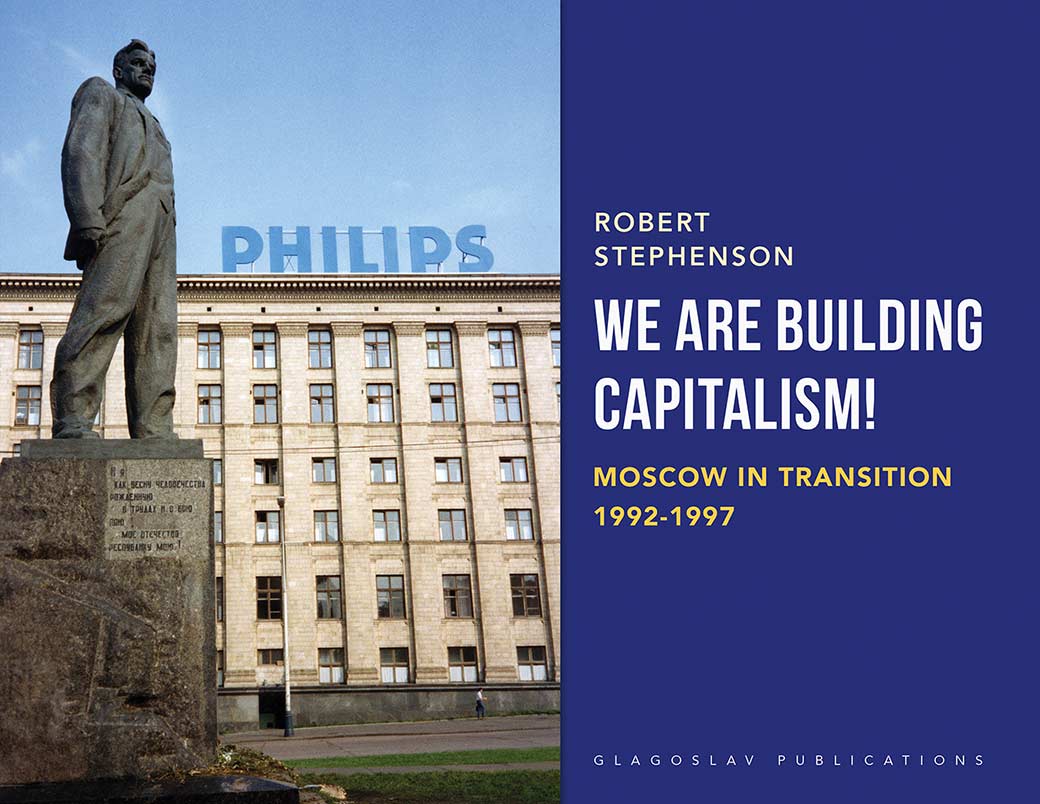
Review: ‘We Are Building Capitalism!’

We Are Building Capitalism! Moscow in Transition, 1992-1997’, by Robert Stephenson (Glagoslav, 2019, ISBN 978-1-912894-02-4)

In this age of smartphones, Instagram, dashcams and drones, we count on a rich supply of images of the world around us, whether we are tourists checking out a hotel’s environs on Google Streetview before booking, or Bellingcat searching Russian soldiers’ Vkontakte pages for pictures to geolocate deployments in the Donbas. We can easily forget how new this visual abundance really is, and take for granted our capacity to mine visual evidence as easily as written text.

It is, after all, a tremendously valuable additional source, as is demonstrated by this collection of photographs from Moscow in the midst of the likhie 1990s – ‘dashing’, ‘wild’ or roaring,’ depending on choice or prejudice. This was a Moscow by turns tawdry and elegant, miserable and modernising, drab and violent – as Vladimir Gel’man says in his introduction, it is not just a companion to a social history of the time, it is a book that “has its own protagonist: Moscow.” (p11) As someone who also has his fascination with this vibrant and , well, likhyi city, I can understand what led Robert Stephenson, a British civil servant sent there as a “technical specialist” in the days when such an attachment was still possible, to chronicle the city’s spaces and structures, (numerous) traumas and (fewer) triumphs.

This is largely a collection of photographs. There are accompanying captions and some sections explaining the context for those who may not know about the 1993 shelling of parliament or the reconstruction of the Cathedral of Christ Saviour, but to be honest I suspect most who pick up with book will know the backdrop. They may also know today’s Moscow, with its shining trams, hipster food malls and wifi. In many ways it is precisely the continuities and contrasts with the 1990s that will be so striking to them, a reminder that not too long ago, Novy Arbat was still Kalinin Street, the Red October factory still made chocolate and the banana was still a novelty.

Stephenson was a chronicler, not a high-concept artist. This is not an Instagram-friendly collection of arty confections, but rather a wide-eyed visual diary of the times. Some of the pictures are unremarkable, some a little cliched – no doubt exactly what someone would likely say looking at my photo stream – but they are honest, not staged, and precisely offer up a record of the minutiae of life in that transition era: a toppled and defaced statue of Khrushchev, the bleak and crumbling façade of the pre-remont Narkomfin building, a crowd whose clothes look more Soviet than modern, a skyline where the Rossiya hotel still looms in its ugly bulkiness but no cyberpunk Moscow-City towers reach for the clouds…

As someone who still remember the 1990s with a complex mix of nostalgia, horror and depression, this was a poignant reminder. As a scholar, though, I think this is a tremendously useful visual source, illustrating and illuminating everything from the reconstruction of the city to the reshaping of its people, economy and culture, and greatly to be welcomed.


Next Book: A Short History of Russia

My next book is A Short History of Russia, coming out in the UK at the end of April with Ebury (details here) and July in the US with Hanover Square (details here). Is is possible to squeeze all of this country’s amazing history – “from the pagans to Putin” –  into a brief book like this? Of course not: it was at once an exhilarating experiment and a heart-breaking one, to try and distil the big themes, the main characters, the pivotal events, knowing there was so much more I would have loved to cover, but couldn’t. All of the Soviet era? One chapter. The ‘Mongol Yoke’? Just about the same. Still, I had fun with it, and also it forced me to think of the wider dynamics, and especially in my case to focus on the stories Russians tell themselves and others about themselves, the way history is reshaped and plundered to suit the needs of today and the dreams of tomorrow.

More as publication gets closer, though feel free to pre-order now (seriously, I’d be very grateful: pre-orders both direct from the publishers and via Amazon have a disproportionate impact on the industry buzz and getting a book noticed for review and promotion), but in the meantime, here is a trio of very short promotional videos I filmed on a recent trip to a very chilly Moscow. (One-shot takes, just on a phone, so don’t expect undue professionalism, and apologies for the poor sound quality…)

A quick update on Putin’s ‘January Revolution’

putin

How can we know for sure what he’s thinking?

I don’t have the time to write anything substantive here, nor the inspiration, given that I’ve already penned three articles on this week’s news. For those of you who may be interested, these are:

The hunt is on for Putin’s successor – a hot take in the Spectator’s Coffee House blog in which I observe that he is “in the classic trap of any authoritarian strongman (or, indeed, any mafia don): when your wealth, status and above all security depend on your position, how can you step down or even back?” and thus is looking for a new ‘father of the nation role’ and a suitable successor: “Putin is looking for his own Putin.”

Far from clinging desperately to power, Putin is now looking for a way out – in the Telegraph, this covers similar ground, but in particular is trying to push back against what I felt were sometimes cross “Putin wants to be president for life” takes.

Two cheers, maybe, for Putin’s ‘January Revolution’? – the third and longest instead considers what the intended but also unintended consequences may be, in Raam op Rusland. I suggest that talk of a “constitutional coup” is wide of the mark, and that although “most revolutions are not carried out in the name of the tsar’s security and longevity”, that ‘January Revolution’ label may indeed some day be seen as accurate.


Correspondences between the Donald and the Ivan: a not-deeply-thought-through musing

I would not suggest that Donald Trump and Ivan the Terrible are that similar, but reading the US president’s frankly rather bizarre letter to Nancy Pelosi about impeachment, I was struck by a similarity.

In 1564, Tsar Ivan IV, Grozny (usually translated as ‘Terrible’ although ‘Awesome’ or ‘Dread’ are probably more accurate) upped sticks from Moscow and headed for the fortified village of Alexandrova Sloboda, writing a letter to the boyars, the aristocrats, in which he savaged them for their purported (and probably real) embezzlement, vindictiveness and disrespect. He made a great show of abdicating the throne.

This was a calculated and cunning gamble. His relationship with the boyars had been rocky to say the least: he mistrusted them deeply (and in fairness probably with good reason), but also needed them to manage his country for him. He wanted not to destroy but to break them. Many may have viewed Ivan’s departure with a certain relief at first, but it soon became clear that they could not do without him. They had no spare tsar in reserve, and an angry Moscow mob was looking ready for some lynchings. So in 1565 they capitulated, begging Ivan to return, and in effect granting him everything he wanted: his own kingdom-within-a-kingdom, the Oprichnina, and the power of life or death over his nobility.

In a way – in a way – the other letter may be read the same way. Sure, in part it is a semi-coherent sermon of spleen, a Trump twitter-thread’s big brother. Whatever his tenuous relationship with manners and grammar, though, he clearly does have a certain visceral political savvy. I read his letter as being in part, and in a way, a similar message: warning his boyars – the powers in the Republican Party – that they have no obvious Trump-substitute in the wings (VP Mike Pence was in that respect well-chosen as someone who scares even many of them), and that if they were not wholly and full-throatedly supportive of the president, they faced today’s answer to the Moscow mob, the rabid Trump base, who may be a minority, but are a loud, active, vindictive and effective one.

From fur robes to red ties, politics really doesn’t change all that much.